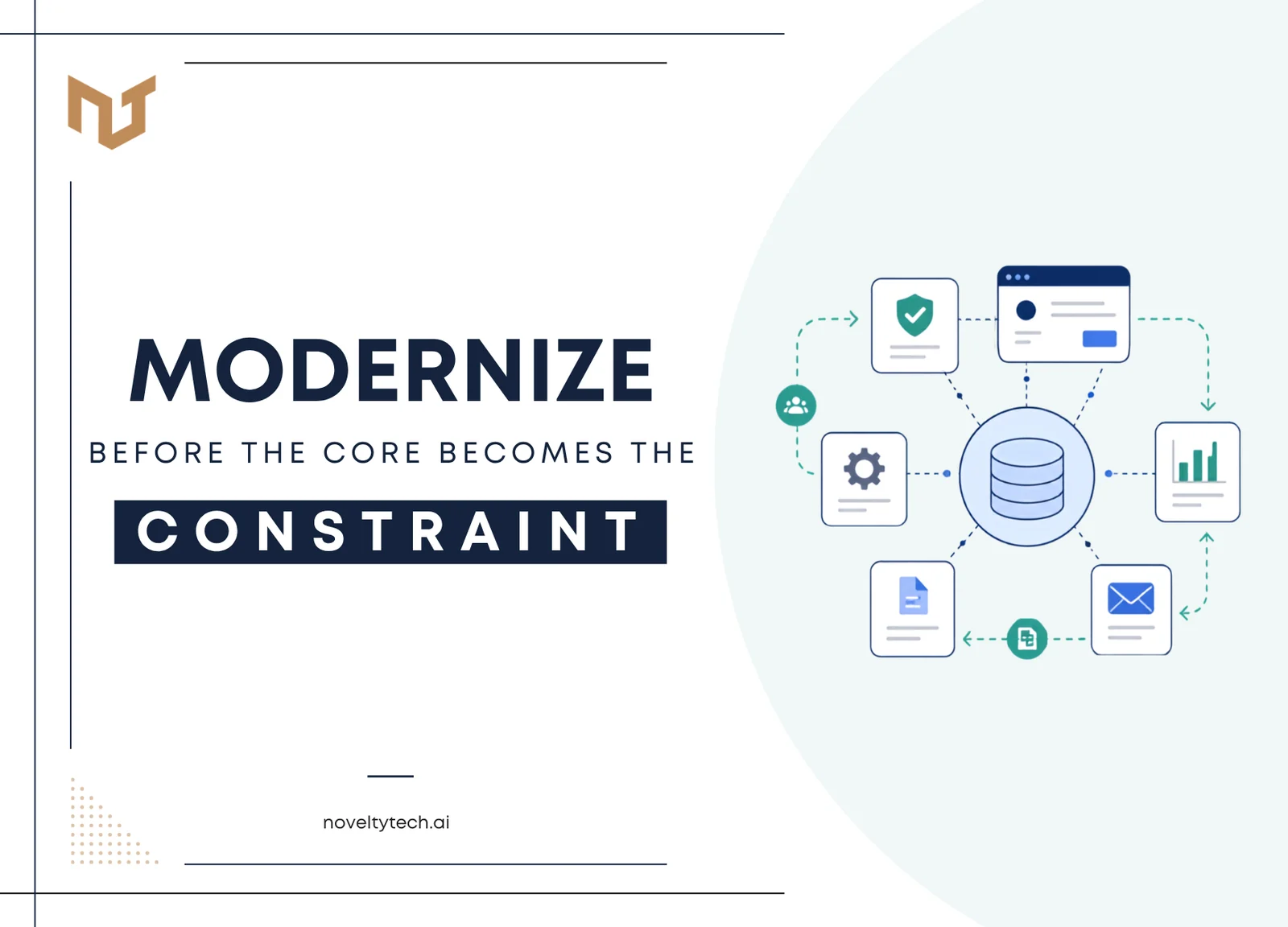
A business-critical system does not have to be failing to need modernization. In many organizations, the more important question is whether the system can continue supporting the business as it grows, changes, and asks more of the technology underneath it.
That distinction matters because mature companies often depend on software that has accumulated years of business logic, integrations, operating knowledge, and technical debt. The platform may still process transactions reliably. Employees know how to use it. Customers may never see an obvious problem. Yet behind that stability, changes may be taking longer, integrations getting harder, and engineering teams spending more effort preserving the system than extending what the business can do with it.
Reliability is only part of the question
Organizations are cautious about changing critical systems for good reason. The deeper a platform sits in the business, the more consequential any change becomes. Important workflows may depend on it. Years of rules and exceptions may be embedded in the code. Other applications may rely on behaviors that are poorly documented but well understood by the people who operate them every day.
That creates a natural preference for preserving what works, and often that is the right call. A mature platform that remains secure, maintainable, economical to operate, and capable of supporting the future does not need to be replaced simply because its technology is old. Age is useful context, but it is not much of a diagnosis.
Stability can also obscure a different kind of risk. A system can continue doing today’s job while becoming progressively less suited to tomorrow’s. The warning signs are rarely dramatic at first. A relatively simple enhancement becomes a multi-sprint effort. A new integration requires another workaround. Testing takes longer because changing one area creates uncertainty somewhere else. Performance is acceptable at current volume, but projected growth begins to narrow the margin. Critical knowledge sits with a small number of people who understand how the platform really works.
None of those conditions necessarily justifies a rebuild on its own. Taken together, however, they can show that the business is beginning to outgrow the technical foundation it depends on. The useful question is no longer simply whether the system works. It is whether the organization can continue depending on it for where the business is going.
When technical debt becomes business debt
Technical debt is often discussed as an engineering concern, but its consequences rarely stay inside engineering.
At first, the cost is measured in developer time. Changes require more investigation. Testing becomes more complex. Older dependencies limit implementation choices. Teams add layers around the existing architecture because touching the core carries too much perceived risk. Any one of those compromises may be entirely rational. Every organization has to balance investment in the future against the demands of today.
The problem comes when temporary accommodations become the permanent operating model. Product improvements take longer to reach customers. Sales opportunities depend on capabilities that are increasingly difficult to introduce. New partners require integrations the platform was never designed to support. Internal teams maintain manual processes because changing the system would take too long. Engineering capacity shifts away from creating new value and toward managing accumulated complexity.
At that point, the consequences are no longer primarily technical. What started as technical debt has become business debt.
The technology is beginning to influence which opportunities the business can pursue, how quickly it can respond, and how expensive meaningful change will be.
This matters most in the systems that matter most. A peripheral application can often be tolerated, replaced, or worked around. A platform that sits at the center of operations, carries years of institutional knowledge, and supports work across the organization is different. The stakes of changing it are higher, but so is the cost of allowing its limitations to shape the business indefinitely.
Modernization should fit the problem
Modernization is not synonymous with replacement. Some organizations do not need to rebuild the core at all. The underlying platform may remain sound while the larger opportunities sit around it: better integrations, cleaner workflows, stronger APIs, improved customer experiences, more useful internal tools, or automation that removes repetitive work.
Other systems need selective intervention. Portions of the architecture may need to be refactored or progressively replaced while proven capabilities remain intact. Business logic that has been refined over years and continues to create value should not be discarded simply because the technology around it needs to change.
There are also situations where the architecture itself has become the constraint. Keeping it in place means adding more dependencies, more exceptions, more specialized knowledge, and more accommodations every time the business needs something new. The company can continue operating, but each year makes the next meaningful change harder. In that environment, a deeper rebuild or replatforming can become the lower-risk decision over the life of the business, even when it requires more discipline and investment in the near term.
That requires engineering judgment, but engineering judgment alone is not enough. The right technical decision depends on how the company operates, where it is growing, what customers expect, which capabilities create business value, and how much change the organization can reasonably absorb. Modernization works best when those considerations are evaluated together rather than when a technical solution is selected first and justified afterward.
Act before the system chooses the timing
The easiest time to postpone modernization is while everything appears to be functioning. There is always another roadmap priority, another customer request, or another quarter in which the current platform can probably keep doing what it has been doing.
The risk is not simply that the system might fail one day. More often, the business gradually loses room to maneuver. A performance issue begins affecting customers just as growth is accelerating. A key engineer leaves with knowledge that was never fully documented. A security requirement forces architectural work on an unfavorable timeline. An important product or partnership opportunity exposes a capability the platform cannot support without disproportionate effort.
The organization is still going to modernize in those circumstances, but now it is doing so under pressure. Choices that could have been evaluated carefully become urgent, and the immediate constraint begins determining the scope and sequence of the work.
Modernizing from a position of strength creates better options. Teams have time to understand the existing application before changing it, identify what deserves to be preserved, and design the future architecture around actual business requirements. Changes can be introduced in stages, tested against real operating conditions, and adjusted without turning the existing platform into a forcing function.
AI-assisted engineering can create meaningful leverage in this kind of work. Novelty uses AI to accelerate activities such as understanding complex codebases, documentation, repetitive implementation work, and testing, allowing experienced engineers to move through parts of a modernization effort faster than traditional methods alone would allow.
AI does not decide which business logic matters, which architectural compromises are acceptable, how much operational risk an organization should assume, or where modernization should stop. Those decisions still require people who understand both the machinery and the business it serves.
Build for what the business needs next
The strongest modernization strategies look forward. What will the business need from this system over the next three to five years? Where will growth place new pressure on it? Which changes are becoming harder or more expensive than they should be? What risks are accumulating quietly? Which parts of the system continue to serve the organization well, and which are beginning to limit it?
Different environments will produce different answers. Sometimes the right move is to improve the experience around a dependable core. Sometimes it is to refactor selected parts of the platform. Sometimes the responsible decision is to modernize the foundation before the business becomes constrained by it.
Novelty does not approach modernization with a predetermined preference for any of those outcomes. We begin by understanding what the organization has today, what the business will need next, and where the technology is creating a gap between the two. From there, the work is deliberate: preserve what continues to create value, change what no longer serves the business, and use AI where it can accelerate delivery without giving up engineering judgment or control.
If your core platform still works but is beginning to shape what the business can do next, now is the right time to take a closer look.