Growth creates work. For a third-party administrator, every new client, plan, member, and transaction arrives with documents to process and information that has to line up across systems.
When technology is working, it absorbs most of that volume. When systems are aging or poorly connected, capacity stays tied to headcount, and each added person adds a handoff.
Leadership usually reads the result as an operations problem: a growing backlog, longer service times, a team that can't keep pace. More often, capable people are compensating for a system that makes the work harder than it needs to be.
Look beneath the backlog

A backlog is a symptom. A claims backlog often begins well upstream of the queue — documents arriving by fax, portal, email, and clearinghouse; attachments classified by hand; an examiner opening three applications before a claim is ready to review.
“The first question isn't ‘what should we automate?’ It's ‘what is creating the work?’”
The same pattern appears elsewhere. A member portal that can't answer “was my claim paid?” sends that question to the phone queue instead. A service rep hunts for information spread across four systems. Two systems disagree on an eligibility date, so someone reconciles them by hand every week.
All of this feels operational, because staff live it daily. The cause usually sits between the systems.
Before you decide to build or buy
Before committing to a platform, an integration, or an automation effort, leadership needs to know which problem it actually has: a system that can't do the work, a system that isn't connected, or a system surrounded by process that grew up around constraints that no longer exist. Questions worth asking:
- Which steps exist for a real business or regulatory reason, and which survive only because of a limitation that has since gone away?
- Would an integration improve the workflow, or just wire more systems to one that should be redesigned?
- Is this frequent or expensive enough to justify the investment?
- Could a focused layer around the core solve it without replacing anything?
- Which decisions have to stay with a person?
Sometimes the answer is to leave a process alone. A low-volume, low-risk task that depends on judgment may never earn back its automation cost. Modernization should follow measurable value.
Start where volume, effort, and value intersect
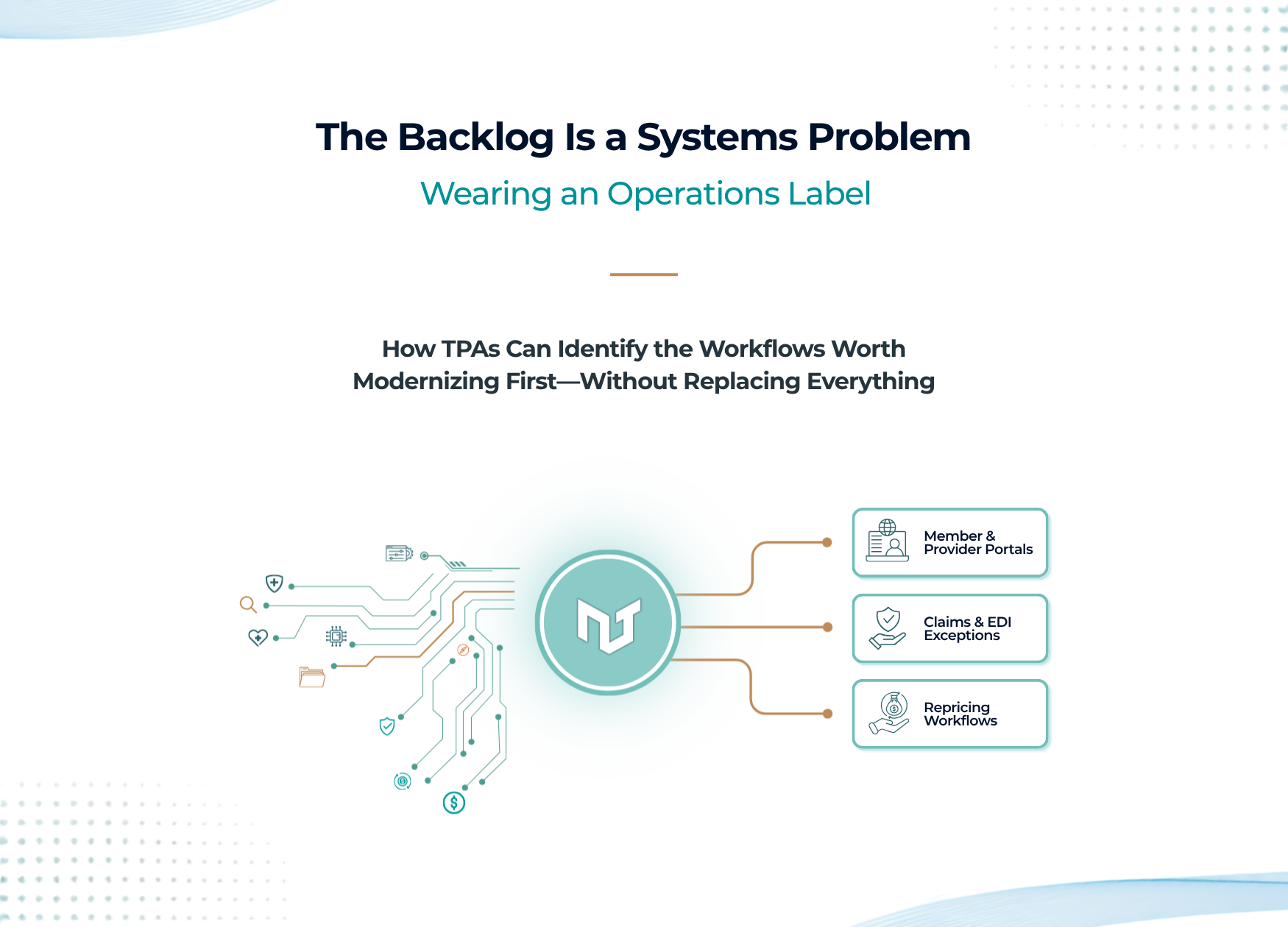
For most TPAs that intersection shows up in a familiar set of places. Member and provider portals, where self-service either resolves a question or routes it to a phone queue. Claims and EDI exception handling, where the exceptions — not the clean 837s — consume the day. Repricing, where manual steps sit directly on top of financial accuracy. Document intake, provider-data maintenance, and queue visibility usually round out the list.
Treat that as a starting point for your own inventory rather than a checklist. Every TPA's mix of systems and constraints is different. What you're looking for is where people are compensating for fragmented information.
Modernize the work around the core
Aging technology doesn't automatically mean the core platform has to go. For many TPAs it still does its job reliably, and the harder problem lives in the work surrounding it. Fixing that work first — a modern layer that changes how information is collected, presented, and routed, while the system underneath stays in place — keeps the number of moving variables small and avoids a multi-year replacement program.
The normal path is not the hard part
Workflows look simple along their expected sequence. They get difficult where information is incomplete, sources disagree, or a connection drops. Those cases have to be designed before production, not patched after.
That matters more once AI is involved. AI can prepare documents and surface information well. Low-confidence or sensitive items should route to a qualified reviewer with the source document still in view, and the decision trail should be something you can produce on demand — for an auditor, a plan sponsor, or an appeal. Authorized people stay responsible for claims, coverage, and pricing decisions. Dependability is worth more here than speed.
Prove it on one workflow
Modernizing everything at once makes it impossible to tell what worked. Define one workflow's boundary. Decide in advance what financial or operational result it should produce. Build it, verify it under realistic conditions — including the exception paths — and watch how it behaves in production. Then expand on the evidence: system performance, staff feedback, and member and provider satisfaction.
The real question
When growth keeps requiring proportional hiring, the useful question isn't whether the team needs more capacity. It's whether the system is converting growth into avoidable work.